
Digital infrastructure investing sounds like one theme, but it is really a stack of different businesses. A powered data center, a fiber-rich network hub, a tower portfolio, and a hyperscale cloud platform can all benefit from the same surge in digital activity, yet they capture value at very different points. For investors, the more useful question is not simply whether cloud and AI keep growing. It is which layer owns the bottleneck when demand rises.
Why the opportunity now depends on power, proximity, and usage growth
The demand side is not hard to find. In their latest annual reports, Microsoft said fiscal 2025 Intelligent Cloud revenue rose 21% and Azure and other cloud services revenue grew 34%, while Amazon reported AWS sales increased 20% in 2025. The IEA also said global data center electricity demand grew 17% in 2025 and projects roughly 950 TWh by 2030 in its central case. (microsoft.com)
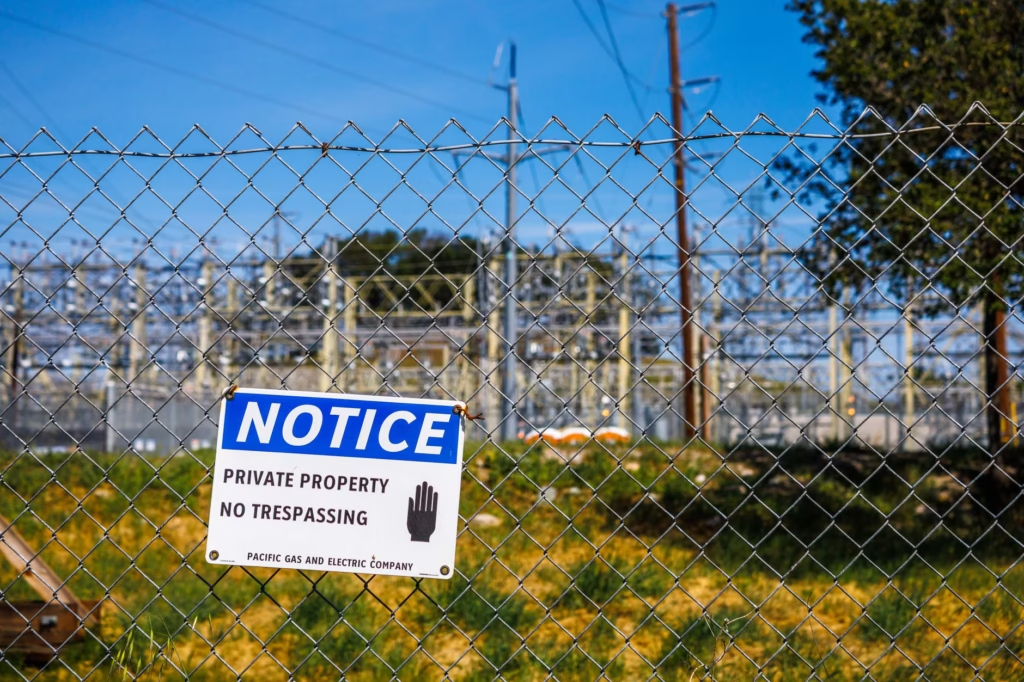
What has changed is that the limiting factor is increasingly physical, not conceptual. The IEA describes tightening bottlenecks in electricity, grid connections, equipment, and permitting, while Equinix says rising data sovereignty, security, and latency requirements are pushing customers toward a distributed local metro footprint. That means digital demand may be global, but the assets that monetize it are often constrained by local power and network conditions. (iea.org)
Each layer of the stack gets paid in a different way
Data center owners and interconnection platforms usually win when they control scarce, well-located capacity. Equinix says a majority of its recurring revenue comes from colocation, with a significant additional stream from interconnection, and it positions its sites as places where enterprises, networks, and cloud providers connect directly. That is an important distinction. A strong data center asset is not just a building full of servers. It is a location where latency, reliability, and connection density can create stickier demand and recurring revenue. (investor.equinix.com)
Network infrastructure is different. Towers, metro fiber, and transport routes can look steadier because they sit underneath long-lived carrier and enterprise traffic. But more traffic does not automatically translate into better economics. The real questions are whether the asset is hard to replicate, whether new tenants can be added cheaply, and whether the route or location solves a problem competitors cannot easily solve. Some network assets behave like quiet compounders. Others end up in a pricing fight.
Cloud platforms offer the most direct exposure to workload growth, but they also carry the most operating complexity. Microsoft’s and Amazon’s latest results show how strong demand can be, yet those same reports also underline that cloud winners are funding massive infrastructure footprints and absorbing technology-cycle risk. That can produce faster growth than a landlord model, but it can also make returns more sensitive to capex discipline, hardware cycles, and pricing decisions. (microsoft.com)

A practical way to screen a digital infrastructure investment
- Start with the scarce input. In one market, that may be grid access, transformer availability, permitted land, metro fiber density, or a hard-to-replicate customer ecosystem. If management cannot explain the bottleneck clearly, the thesis is probably too loose. (iea.org)
- Map the revenue model next. Recurring colocation or lease revenue behaves differently from consumption-based cloud revenue. The first usually offers clearer visibility; the second can offer more upside, but also more operating volatility. (investor.equinix.com)
- Check who has to spend ahead of demand. A business that must build large amounts of capacity before revenue arrives deserves a different risk assessment from one that can expand in smaller, more contracted increments. (iea.org)
- Stress-test the balance sheet and customer mix. Digital infrastructure can look defensive until refinancing gets expensive, a major tenant slows expansion, or a power project is delayed.
A simple hypothetical makes the difference clearer. Imagine two companies both benefiting from AI demand. One owns fully permitted data center capacity near reliable power and earns recurring revenue under multi-year customer commitments. The other is ramping cloud capacity aggressively in expectation of future usage. Both may be exposed to the same secular theme, but they are not the same investment. The first is closer to a constrained-asset story; the second is closer to an execution and capital-allocation story. (iea.org)
This is sector analysis, not personalized investment advice. In digital infrastructure, valuation, leverage, rate sensitivity, tax structure, and customer concentration can change the attractiveness of the same theme very quickly.
The cleanest way to think about digital infrastructure investing is to follow the bottleneck rather than the buzzword. Cloud growth is real, but investor returns usually show up first where rising demand meets scarce power, scarce connectivity, or scarce customer access. That is where pricing power and durability are most likely to emerge. (microsoft.com)
References
- International Energy Agency, Key Questions on Energy and AI (2026) – https://www.iea.org/reports/key-questions-on-energy-and-ai
- Equinix 2025 Annual Report – https://investor.equinix.com/sec-filings/all-sec-filings/content/0001101239-26-000032/eqix-20251231.htm
- Microsoft Annual Report 2025 – https://www.microsoft.com/investor/reports/ar25/index.html?msockid=0f6aafcd7add6db30694b9437bc26c8b
- Amazon.com 2025 Form 10-K – https://www.sec.gov/Archives/edgar/data/1018724/000101872426000004/amzn-20251231.htm
