
Because bonds can still make payments of interest even if their price falls, a bond fund can pay distributions even when the fund is losing value. In that case, the income you receive is realized, but your total return is actually negative. This is because the price has declined by more than the amount of income distributed.[3][4]
There is a second issue. When a distribution is paid, the net asset value (NAV) of the fund falls because cash is distributed to the shareholders. Separate the two aspects of the transaction before you reach any conclusion. The first is the bookkeeping adjustment, and the second is a decline in the value of the fund in the open market.[1]
Imagine that I am at the kitchen table. I see a payment for the month, and I’m happy, until I notice that the balance has fallen again. I immediately look for a reason to believe something is wrong with the fund. I look through the history of distributions, and add the cash received to the remaining share value. That is the comparison I need to make.
Count the income, but don’t count it twice
Here’s a hypothetical example. You invest $10,000, take $400 of distributions in cash, and finish the year with fund shares worth $9,300. With no other purchases or sales, your combined ending value is $9,700. Your total return is ($9,300 + $400, $10,000) ÷ $10,000 =, 3%, before personal taxes and transaction charges. Looking only at the shares would overstate the loss; looking only at the payouts would miss it.[3]
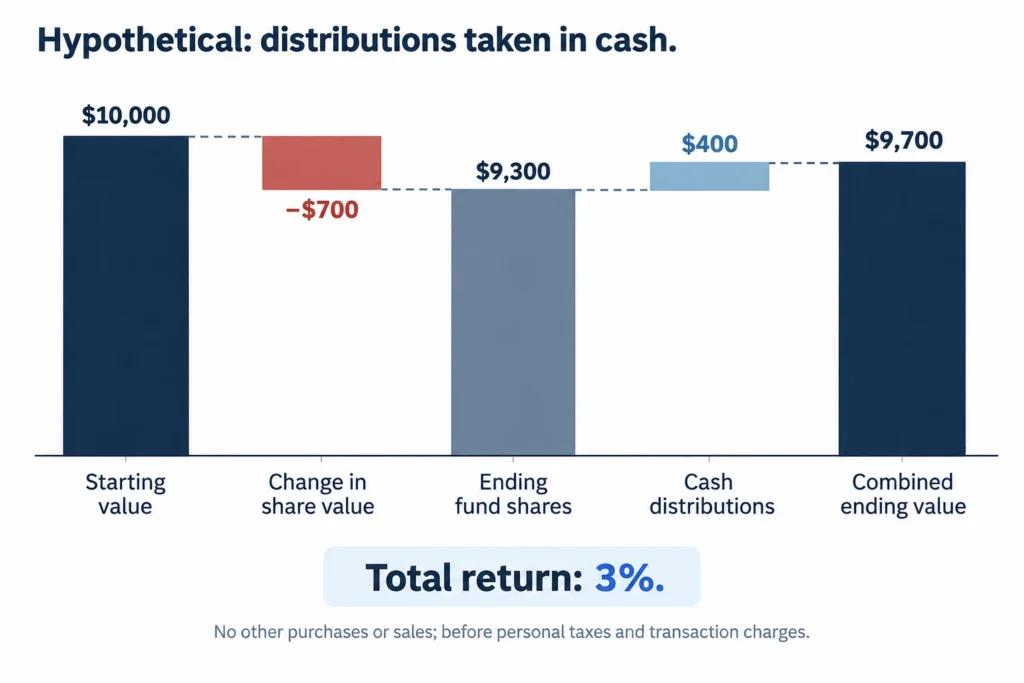
Distributions are included in your final total. Reinvesting them duplicates the money. Make sure you understand the assumptions behind fund total returns. They assume distributions are reinvested.[1][7]
The concept of distribution adjustment is easiest to see when considering a single share. Assume the net asset value (NAV) of a share is $10 and a distribution of $0.10 is made. Ignoring market changes, after the distribution the share is worth $9.90 and you have $0.10 in cash. You have not lost $0.10. With an ETF, the share price need not reflect the NAV, and the market price may not track the distribution adjustment precisely.[1][7]
Why interest rates can overwhelm the payout
A fixed-income security generally provides an agreed-upon stream of payment over a specified period of time. Its price falls to the point at which its yield is in line with similar securities. The issuer need not miss a payment for this to occur. A fund that holds only government securities can also lose market value with a change in interest rates.[2][4]
Duration measures the price sensitivity of a bond to changes in interest rates. While it is quoted in years, it is not the time until maturity of the bond. In this case, it gives us a broad range of price movement to expect with a change in interest rates.[2]
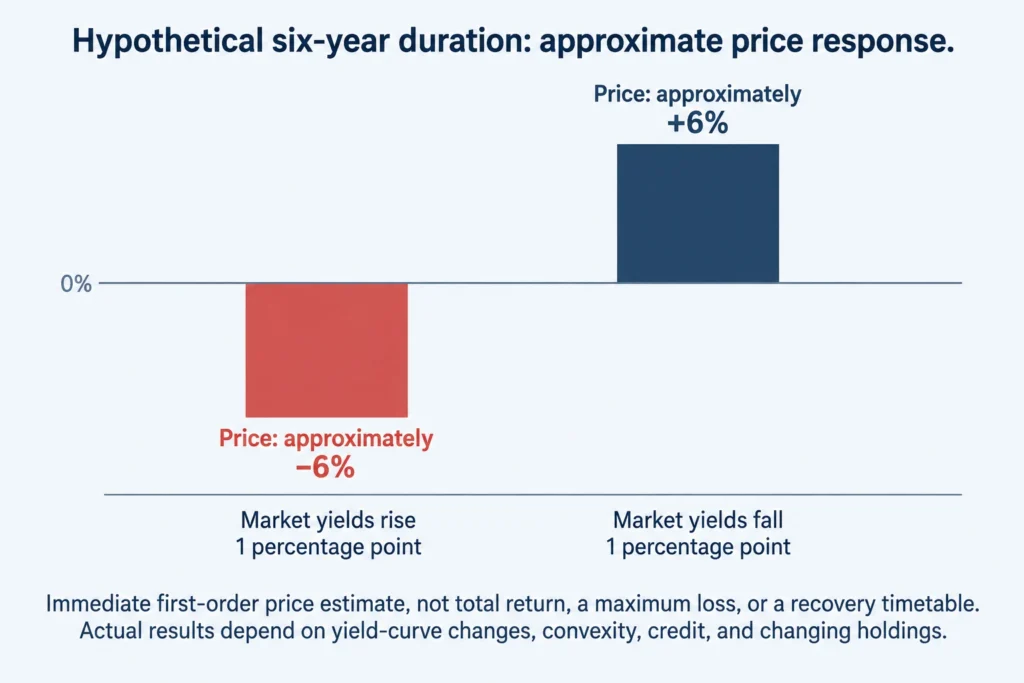
I would use that estimate to size the exposure and not to forecast your year end balance. It provides an estimate of the price change and ignores the income that the investment would produce over the holding period. It also does not indicate the downside risk that the investment would experience. The shape of the curve across maturities and the curvature of the price of the bond (called convexity) would also need to be considered. Condition of the credit market and the holdings of the fund would also need to be analyzed. For example, if mortgage borrowers were to pay off their mortgages slower, this would impact a fund's sensitivity.[2][7]
Higher yields can eventually improve income as the portfolio reinvests cash at better rates. That’s useful, but it doesn’t undo the initial decline on demand. I wouldn’t treat “six-year duration” as a promise that your purchase price will return in six years.[2][7]
Credit losses are a different problem
Confidence in the credit worthiness of the issuer can decline for a variety of reasons. Changes in investors' perception of risk, even if no payment is missed, can result in a decline of a bond's price, and a rise of broader interest rates.[7]
Default goes even further. If the issuer does not meet a debt obligation, investors are left with unpaid interest and potentially a smaller principal. This is payment impairment and is not simply a lower valuation in the market. I would not feel at ease with a continuing fund payout. Income from other bonds may allow the fund to continue making payouts to unitholders.[4][5][7]
The bonds may mature. Your fund usually doesn’t.
This is where “just hold it to maturity” becomes misleading. The average bond fund rolls over investments and buys more when holdings are called. For example, the iShares Core U.S. Aggregate Bond ETF may replace a bond that does not meet the index guidelines. This is just one example of many possible fund designs.[7]
| Investment | Scheduled endpoint | What you receive |
|---|---|---|
| Ordinary rolling bond fund | Usually no fixed termination date | When you sell, the prevailing share value, not a promised repayment of your original investment. |
| Individual fixed-rate, noncallable bond | Contractual maturity date | Contractual face value if the issuer performs, plus scheduled interest payments along the way. |
| Defined-maturity ETF | Specified termination year or date | Remaining net assets after liabilities, not a predetermined principal amount. |
Face value matters. If you pay $1,050 for an individual bond with $1,000 face value, the contractual maturity payment is $1,000, not your $1,050 purchase price. Coupons still count toward your overall return. Holding that bond to maturity preserves its scheduled nominal payments only if the issuer performs; it doesn’t eliminate default risk or inflation’s erosion of purchasing power.[5]
Holding a bond does not eliminate interim economic loss. For example, if a bond is issued at a yield below the market yield and interest rates rise, that bond may trade at less than its face value, and investors may be unwilling to purchase it. Just because a bondholder doesn’t sell a bond that has become less economical, does not mean nothing has changed economically.[2][5]
Start with when you need the money
Look at a fund's credit quality and duration, and see if there's an end date to its exposure. Average maturity is not a proxy for duration. Without your cash flows and holding, I can only provide an analysis and describe mechanics of a possible loss, but I can't say for sure it was due to one of those mechanics.[2][3][4]
Then translate duration into dollars. If a hypothetical one-percentage-point yield rise implies a $600 price decline on money earmarked for a $10,000 bill next year, ask whether you could cover that shortfall without postponing the payment. That’s a useful rate-risk screen, not a worst-case estimate or a rule that duration must equal your time horizon.[2]
For an expected, ongoing expenditure, price variability may be a risk you are willing to take. For a lump sum expenditure that occurs in the future, the price available on the given date is the most important consideration. I would evaluate a fund based on that by looking to see if the next distribution would be made on time.
Sources and references
- SEC Office of Investor Education and Assistance: Fund Distributions, Investor Bulletin (2026-08-19)
- FINRA: Brush Up on Bonds: Interest Rate Changes and Duration (2024-09-19)
- FINRA: Bonds
- SEC Investor.gov: Bond Funds and Income Funds
- SEC Office of Investor Education and Assistance: What Are Corporate Bonds?
- BlackRock / iShares: iBONDS ETFs product brochure
- BlackRock / iShares: AGG Summary Prospectus (2026-06-29)
