
Clean energy investing has outgrown the old idea that it is mostly a wager on a handful of solar stocks. The investable universe now includes regulated utilities building transmission, renewable power developers, battery and grid-equipment suppliers, electrification businesses, and a more speculative layer of hydrogen and other emerging technologies. That breadth matters because the long-term case is increasingly driven not only by climate goals, but also by electricity demand growth, energy security, industrial policy, and the falling cost of many renewable technologies. Global clean energy spending is estimated at about USD 2.2 trillion in 2025, roughly double fossil-fuel investment, while electricity demand is forecast to keep rising through 2030 as EVs, cooling, heat pumps, industry, and data centers add load. (iea.org)
TL;DR
- The strongest long-term case is broader electrification, not a single solar or wind stock. Clean energy investment is projected at about USD 2.2 trillion in 2025, and electricity demand is expected to keep rising through 2030. (iea.org)
- Lower technology costs help adoption, but they do not guarantee shareholder returns. The IEA says major solar and wind manufacturers have reported losses even as installations keep growing. (iea.org)
- Grid constraints are now central to the investing story. The IEA says more than 2,500 GW of renewable, large-load, and storage projects are stalled in grid queues globally. (iea.org)
- Policy risk is real. In the U.S., IRS guidance reflects 2025 legislative changes that terminate certain clean electricity credits for applicable wind and solar facilities placed in service after December 31, 2027. (irs.gov)
- For most individual investors, clean energy fits better as a diversified sleeve inside a broader portfolio than as an all-in thematic bet. Narrow funds are not automatically diversified. (investor.gov)
The real long-term thesis is electricity, not hype
The clean energy case looks stronger when it is framed as an electricity and infrastructure story. The IEA expects solar to remain the largest single item in global energy investment in 2025, with battery spending also climbing, while its electricity outlook points to brisk demand growth through 2030. In other words, the sector is being pulled forward by real system needs: more power generation, more network capacity, more flexibility, and more equipment that can connect new supply to new demand. (iea.org)
Cost matters just as much as demand. IRENA’s 2024 cost review says renewables remained the most cost-competitive source of new power in 2024, with 91% of newly commissioned utility-scale renewable projects delivering electricity at a lower cost than the cheapest new fossil-fuel alternative. That helps explain why capital keeps flowing into the space even when politics becomes less predictable. But lower costs do not benefit every listed company equally. Cheaper hardware can expand adoption while squeezing the margins of manufacturers that sell increasingly commoditized products. (irena.org)
Clean energy is a value chain, not a single sector
A useful starting point is to separate business models instead of talking about “clean energy” as if it were one homogeneous trade. Two companies can sit under the same theme and have completely different economics, risk drivers, and valuation logic.
| Exposure type | What tends to drive returns | What can break the thesis | Typical role |
|---|---|---|---|
| Regulated utilities and transmission owners | Allowed returns on network investment, rising load, grid upgrades | Regulatory lag, cost overruns, higher financing costs | Core or lower-volatility exposure |
| Renewable developers and independent power producers | Asset pipelines, long-term contracts, storage build-out, project execution | Interconnection delays, curtailment, merchant power-price swings, refinancing risk | Moderate-risk growth and income exposure |
| Grid equipment, inverters, transformers, cables, and software | Electrification spending, grid bottlenecks, utility capex, replacement cycles | Order-cycle slowdowns, supply-chain constraints, pricing pressure | Targeted picks on the enabling layer |
| Commodity hardware manufacturers such as modules, cells, and some turbine makers | Unit growth and capacity expansion | Price wars, oversupply, tariffs, weak margins, inventory resets | Higher-risk cyclical exposure |
| Frontier technologies such as low-emissions hydrogen or early-stage decarbonization platforms | Policy support, pilot-to-scale adoption, strategic partnerships | Commercialization risk, uncertain offtake, changing incentives, funding gaps | Speculative satellite allocation |
This distinction matters because the same demand tailwind can produce very different outcomes for shareholders. The IEA’s current outlook shows grid bottlenecks becoming more severe, while it also notes that many renewable manufacturers are struggling financially despite strong deployment. Hydrogen, meanwhile, remains a higher-uncertainty segment where project pipelines have been reduced by delays and cancellations. A clean energy label tells you very little by itself. (iea.org)
Use the revenue-stack test before buying anything
A simple practical screen, not a formal industry standard, is what this article calls the revenue-stack test. The goal is to identify how the business actually gets paid, what must go right for the investment to work, and which risks the market may be underpricing.
- Start with the revenue source. Is the company paid through a regulated return, a long-term power purchase agreement, equipment sales, software subscriptions, or spot-market exposure?
- Ask who sets the price. A regulator, a fixed contract, and a competitive commodity market create very different risk profiles even if all three businesses operate in the same transition theme.
- Map the dependency chain. Does the thesis depend on smooth permitting, tax-credit eligibility, cheap debt, a utility interconnection approval, and a customer signing offtake at the same time? The more links in the chain, the less durable the expected return.
- Stress the balance sheet. Capital-intensive businesses can look attractive during expansion and fragile during delays. Debt maturity schedules, cash burn, and dilution risk matter as much as technology narratives.
- Separate customer value from shareholder value. A technology can be useful for the grid and still be a poor stock if competition destroys pricing power.
If an investment only works under generous subsidies, fast-falling rates, premium valuations, and flawless execution, treat it as speculative exposure rather than core portfolio infrastructure.
Where opportunity looks more durable
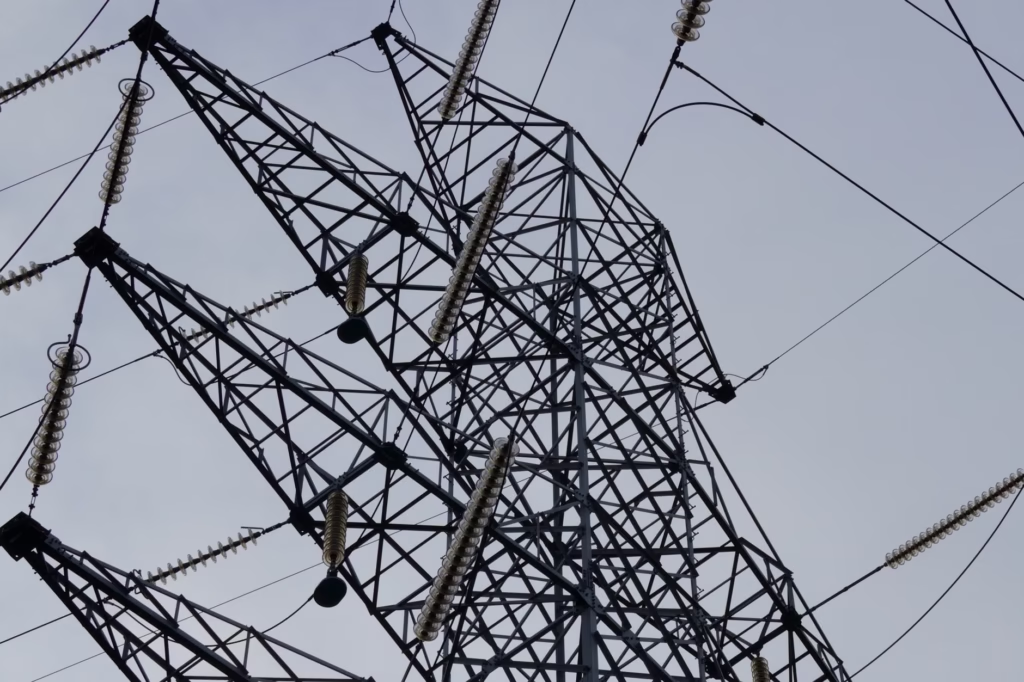
Grid infrastructure stands out because it solves a bottleneck that is already visible, not merely forecast. The IEA says a lack of grid capacity is slowing the deployment of new generation, storage, and demand, with more than 2,500 GW stalled in queues worldwide. It also says annual grid investment needs to rise materially from current levels, while planning and permitting new grid infrastructure can take 5 to 15 years. That points investors toward transmission owners, utilities, and suppliers of critical equipment rather than only upstream generation names. (iea.org)
Storage and flexibility are another relatively durable area because they help the system absorb higher shares of variable renewables. The U.S. EIA projected record utility-scale battery additions in 2025, and the IEA continues to frame storage and demand flexibility as central tools for grid stability and congestion management. That does not mean every battery company is attractive. The stronger cases are often the businesses with integration know-how, power electronics, software, or project economics that do not depend entirely on commodity cell pricing. (eia.gov)

Contracted asset owners and some electrification enablers also deserve attention. The IEA expects corporate PPAs, utility contracts, and merchant plants to remain major drivers of renewable build-out, while electricity demand growth is being supported by EVs, cooling, heat pumps, industry, and data centers. Businesses selling into that broader electrification wave can offer cleaner economics than pure-play technology bets because they benefit from rising system demand even when one specific generation technology goes through a rough cycle. (iea.org)
What can go wrong even if the energy transition keeps advancing
Policy and incentive revisions can remake project economics
The clean energy story is not policy-only, but policy still matters a great deal. The IEA’s 2025 renewables outlook revised expected global growth lower in part because of policy, regulatory, and market changes, and it cut the U.S. forecast sharply because of changes including earlier tax-credit phaseouts and import restrictions. On the U.S. tax side, IRS guidance reflecting 2025 legislative changes states that certain clean electricity credits for applicable wind and solar facilities placed in service after December 31, 2027, are terminated. Investors should treat any policy-supported cash-flow model as revisable, not permanent. (iea.org)
Capital costs still bite hard in a capital-intensive sector
Many clean energy businesses need large upfront capital and long lead times, which makes them sensitive to rates, credit conditions, and schedule slips. The IEA notes that higher interest rates and currency pressures are already making capital harder to access in some markets, and its grid analysis shows that network projects can take far longer to complete than generation or demand-side installations. When the asset is long-duration and heavily financed, a seemingly small change in the cost of capital can alter valuation, project viability, or both. (iea.org)
Oversupply can punish manufacturers while helping adoption
One of the biggest clean energy investing mistakes is assuming that strong deployment automatically means strong profits for the companies making the hardware. The IEA explicitly says major solar PV and wind manufacturers have reported large losses despite surging installations, and it links weak margins to price declines, overcapacity, and intense competition. The technology can win. The customer can win. The manufacturer’s equity can still lose. (iea.org)
Supply-chain concentration and trade friction are easy to underestimate
The IEA also warns that solar PV supply chains and rare-earth inputs for wind remain highly concentrated, with some key PV production segments still expected to remain more than 90% concentrated in one country by 2030. That does not make the transition impossible, but it does raise real geopolitical and company-specific risk. Tariffs, export controls, sourcing rules, and trade disputes can move earnings faster than demand growth can offset them. (iea.org)
Interconnection and curtailment can ruin a good project in the wrong place
Grid access is not an abstract engineering detail. It is an investing variable. Berkeley Lab’s latest queue data show that the U.S. still has a massive backlog of generation and storage projects seeking transmission interconnection, and the IEA says curtailment and congestion are rising in multiple markets as variable renewable penetration grows. A developer with a strong pipeline on paper can face much weaker economics if projects sit in queues too long, require expensive upgrades, or end up in markets with frequent negative pricing and curtailment. (emp.lbl.gov)
Thematic funds can still be concentrated and messy
A clean energy ETF label is not a substitute for due diligence. SEC rules generally require a fund whose name suggests a specific investment focus to follow an 80% investment policy, but that still leaves room for different definitions, country mixes, market-cap profiles, and a meaningful remainder outside the theme. Investor.gov also warns that narrowly focused funds are not automatically diversified. For investors, the practical implication is simple: read the holdings, not just the fund name. (sec.gov)
A practical way for individual investors to build exposure
This is general information, not personalized investment advice. For many readers, the most sensible approach is to decide what role clean energy should play in the portfolio before deciding which security to buy. Because thematic funds can be narrow, clean energy often works better as one sleeve within a diversified asset allocation than as a full portfolio identity. (investor.gov)
- Decide the role. Is this a core long-term allocation, an infrastructure-and-income tilt, or a speculative growth sleeve?
- Choose the vehicle that matches that role. Broad market funds with clean-energy exposure, utility and industrial names, thematic ETFs, and single stocks all behave differently.
- Apply the revenue-stack test. If you cannot explain how the business gets paid and what could interrupt that cash flow, the position size is probably too large.
- Check concentration. Review top holdings, geography, market-cap mix, debt load, and whether the fund or company depends heavily on one policy regime or one technology cycle.
- Monitor a short list of signals. Policy changes, interconnection progress, backlog quality, margins, capital-raising needs, and grid investment trends usually tell more than promotional narratives do.
A hypothetical example shows why this matters. An investor with a 15-year horizon could buy a diversified mix of utilities, electrical equipment firms, and renewable asset owners and get exposure to rising electricity demand, grid build-out, and storage. Another investor could buy a basket of smaller hydrogen developers and solar-module manufacturers. Both portfolios can be described as clean energy investing. The first is mainly exposed to infrastructure demand and execution. The second is far more exposed to policy shifts, pricing pressure, and capital-market risk.
How to think about long-term potential without overpaying for the story
The strongest long-term clean energy ideas tend to solve present-day problems, not just future ones. Lower-cost generation, more grid capacity, system flexibility, and equipment that helps handle rising electricity demand have an immediate customer value proposition. That is a sturdier foundation than a thesis that depends on investor enthusiasm alone. The macro backdrop still points to expanding demand for power and continued large-scale clean energy investment, even if the path remains uneven. (iea.org)
The more speculative end of the market needs a higher standard of proof. Hydrogen may yet become important in selected industrial and fuel applications, but the IEA’s 2026 review says the announced low-emissions hydrogen project pipeline has shrunk to 27 Mt by 2030 because of delays and cancellations. That does not make the segment uninvestable. It means it should usually be treated as frontier exposure, with smaller position sizes and more skepticism about timelines. (iea.org)
Clean energy investing works best when the business model is clearer than the slogan
Clean energy has real long-term potential, but it is not one trade and it is not automatically a good investment just because the broader transition continues. The sector’s better opportunities are often found where durable demand meets workable economics: grids, storage, contracted assets, and electrification enablers. The weaker setups are usually the ones that rely on fragile margins, heroic policy assumptions, or a still-unproven commercial market. A practical next step is to review any current holding or watchlist through the revenue-stack test, then decide whether it belongs in the core of a diversified portfolio or in a clearly limited speculative sleeve. (iea.org)
Frequently asked questions
Is clean energy investing only about renewable power stocks?
No. The investable universe is broader than solar and wind developers. The IEA’s clean energy investment definition includes renewables, nuclear, grids, storage, low-emissions fuels, efficiency, and electrification, which is a good reminder that the transition creates multiple kinds of exposure. (iea.org)
Why have some clean energy stocks struggled even though renewable deployment keeps growing?
Because technology adoption and equity returns are not the same thing. The IEA says major solar PV and wind manufacturers have reported losses despite strong installation growth, largely because price competition and oversupply can erode margins even while end-market demand rises. (iea.org)
Are clean energy ETFs automatically diversified?
No. Investor.gov says narrowly focused funds are not automatically diversified, and SEC naming rules do not eliminate concentration risk. A fund name can be a useful clue, but the holdings, top weights, geography, and market-cap mix still need to be checked. (investor.gov)
Is clean energy investing mainly a policy bet?
Policy is important, but it is not the whole story. The current investment wave is also being supported by electricity demand growth, industrial policy, energy security concerns, and cost competitiveness. At the same time, recent U.S. tax-credit changes show that policy revisions can materially alter project economics, so investors should not treat today’s support structure as fixed forever. (iea.org)
What is a reasonable place to start if I want exposure but not extreme volatility?
Many investors will be better served by starting with diversified exposure and then adding selective thematic positions only if they understand the underlying business models. In practice, that often means looking first at broader funds, utilities, grid infrastructure, or established asset owners before committing meaningful money to speculative frontier technologies. This is a portfolio-construction judgment, not personalized advice. (investor.gov)
References
- IEA – World Energy Investment 2025 executive summary – https://www.iea.org/reports/world-energy-investment-2025/executive-summary
- IRENA – Renewable Power Generation Costs in 2024 – https://www.irena.org/Digital-Report/Renewable-Power-Generation-Costs-in-2024
- IEA – Renewables 2025 executive summary – https://www.iea.org/reports/renewables-2025/executive-summary
- IEA – Electricity 2026: Demand – https://www.iea.org/reports/electricity-2026/demand
- IEA – Electricity 2026: Grids – https://www.iea.org/reports/electricity-2026/grids
- U.S. EIA – Solar, battery storage to lead new U.S. generating capacity additions in 2025 – https://www.eia.gov/TODAYINENERGY/detail.php?id=64586
- Lawrence Berkeley National Laboratory – Queued Up: 2025 Edition – https://emp.lbl.gov/publications/queued-2025-edition-characteristics
- IRS – Internal Revenue Bulletin 2025-36 – https://www.irs.gov/irb/2025-36_IRB
- Investor.gov – Beginners’ Guide to Asset Allocation, Diversification, and Rebalancing – https://www.investor.gov/additional-resources/general-resources/publications-research/info-sheets/beginners-guide-asset
- SEC – 2025 – 26 Names Rule FAQs – https://www.sec.gov/rules-regulations/staff-guidance/division-investment-management-frequently-asked-questions/2025-26-names-rule-faqs
- IEA – Global Hydrogen Review 2026 executive summary – https://www.iea.org/reports/global-hydrogen-review-2026/executive-summary
