
Long-term market calls usually go wrong when they collapse into a slogan. A better approach is to look for structural forces that are already visible in policy, capital spending, demographics, and market plumbing. As of mid-2026, official research from the IMF, BIS, IEA, World Bank, Federal Reserve, and SEC points to a backdrop of heavier public borrowing, more trade friction, rapid AI-linked investment, rising electricity needs, and deeper changes in how capital reaches businesses. Those forces will not move in straight lines, but they are strong enough to influence sector leadership, valuation regimes, and risk premiums through the 2030s. (imf.org)
This article is educational, not personalized investment advice. A trend can be real and still produce weak returns if the entry price is too high, the policy backdrop changes, or the bottleneck shifts to another part of the value chain.
TL;DR
- AI is turning into a capital-spending and electricity story, not just a software story. (iea.org)
- Industrial policy, tariffs, and supply-chain resilience are likely to keep affecting valuation gaps across regions and industries. (imf.org)
- The clean-energy transition is increasingly about grids, storage, and critical minerals, while climate adaptation is creating a parallel infrastructure theme. (iea.org)
- Aging populations, private credit growth, and heavier sovereign borrowing could reshape both earnings growth and discount rates. (elibrary.imf.org)
- Market structure matters too: ETF growth, index concentration, and tokenized securities can change how money flows and where risks build. (sec.gov)
Use a three-layer trend map before chasing a theme
A practical way to evaluate any long-term market theme is to map it through three layers. First, identify the demand creators: the companies or sectors that directly benefit if the trend grows. Second, identify the bottlenecks: the assets, inputs, or infrastructure that become scarce if the trend succeeds. Third, identify the financing channels: the lenders, fund structures, or balance sheets that make the buildout possible. This matters because the obvious story is not always where the best risk-adjusted return ends up. AI is the clearest current example: the headline winners may be software and chips, but the underlying constraints often sit in power, cooling, transmission, fiber, and project finance. (iea.org)
- Demand creators: Who gets more revenue if the trend keeps expanding?
- Bottlenecks: What becomes scarce, harder to permit, or more expensive?
- Financing channels: Who provides the capital, and what happens if funding costs rise?
A hypothetical example helps. Suppose an investor believes AI will keep reshaping markets. A narrow response is to buy a single software or chip name. A broader response is to ask what AI deployment physically requires: computing hardware, electricity, substations, cooling, data-center land, networking gear, and financing for enormous capex plans. That approach does not guarantee better returns, but it usually produces a sturdier thesis than a one-stock bet.
A quick reference for the decade ahead
| Trend | Where it may show up | Signals to watch | Main risk |
|---|---|---|---|
| AI as an industrial capex cycle (iea.org) | Semiconductors, networking, cooling, industrial landlords, equipment makers | Big-tech capex plans, data-center buildouts, chip lead times | Overpaying for obvious winners |
| Power, grids, and electricity demand (iea.org) | Utilities, transmission, gas generation, storage, electrical equipment | Interconnection queues, rate-base plans, power pricing | Permitting and regulatory delays |
| Industrial policy and reshoring (imf.org) | Semiconductors, strategic manufacturing, local supply chains | Subsidy programs, announced plant investment, trade rules | Excess capacity and poor subsidy economics |
| Resilience over pure efficiency (imf.org) | Logistics, inventory systems, regional manufacturing, commodity security | Tariff changes, sourcing diversification, supplier concentration | Building expensive redundancy |
| Energy transition infrastructure (iea.org) | Copper, grid equipment, storage, recycling, select miners | Grid spending, mineral supply additions, renewable deployment | Commodity oversupply despite strong demand |
| Climate adaptation and resilience (worldbank.org) | Water, drainage, grid hardening, engineering, insurance-linked repricing | Municipal capex, resilience standards, disaster-loss patterns | Assuming adaptation is only an ESG niche |
| The silver economy (elibrary.imf.org) | Healthcare, long-term care, retirement income, productivity tools | Labor-force participation, health trends, pension stress | Slower growth offsetting demand gains |
| Private credit expansion (federalreserve.gov) | BDCs, insurers, private funds, financing for middle-market firms | Default trends, fundraising, bank exposure, covenant quality | Illiquidity and stale valuations |
| Heavier sovereign borrowing (imf.org) | Government bonds, rate-sensitive equities, duration trades | Term premiums, issuance mix, buyer base, inflation expectations | Ignoring discount-rate risk |
| Market-structure change (sec.gov) | ETFs, exchanges, custody, settlement, tokenized securities | ETF fee pressure, concentration, rule changes, trading rails | Confusing easier access with lower risk |
1. AI turns from a software narrative into an industrial capex cycle
By April 2026, the IEA said capital expenditure by five large technology companies had climbed above $400 billion in 2025 and was set to rise further in 2026, driven heavily by data-center investment. That is why AI should be treated as a broader buildout story, not just a software story. The likely beneficiaries span semiconductors, optical networking, cooling systems, construction, and specialized power equipment. The main investing mistake is to assume every company associated with AI deserves a premium forever. Competitive intensity, model commoditization, and huge spending requirements can weaken returns even when demand is real. (iea.org)
2. Electricity, grids, and data-center power become strategic assets
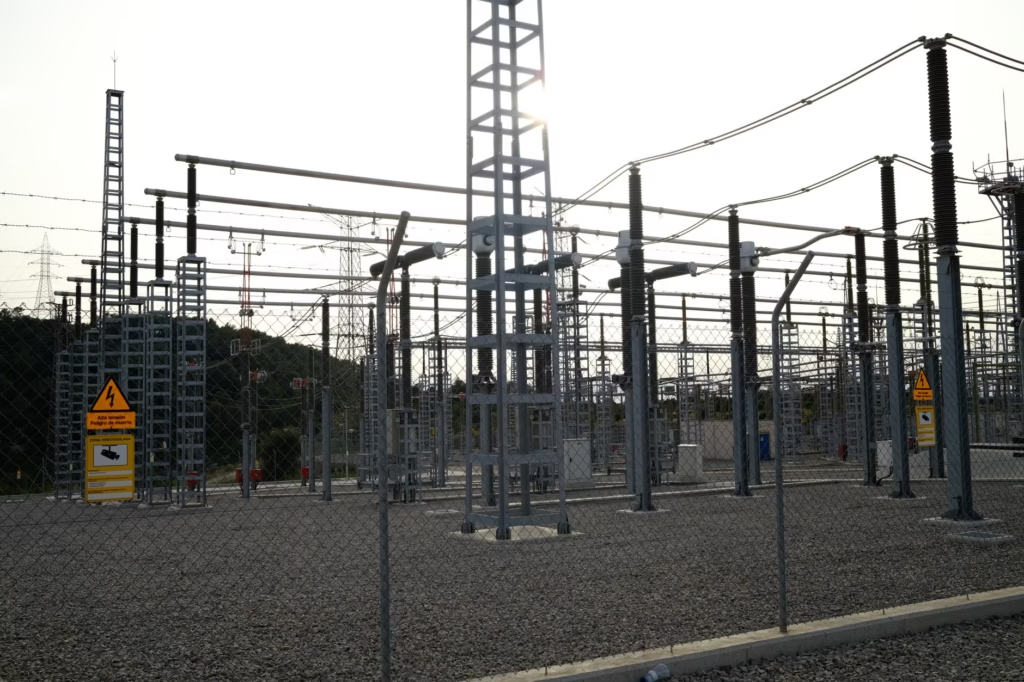
The AI buildout runs into a physical constraint: power. The IEA’s 2025 and 2026 work on electricity demand and AI points to data centers as a major reason forecasts for U.S. power demand were revised higher. In the United States, data-center electricity demand was around 180 TWh in 2024 and is projected to keep rising sharply through 2030. That does not mean every utility is a winner, but it does raise the importance of generation mix, transmission access, permitting, and balance-sheet capacity. In this theme, local regulation and project execution may matter as much as macro demand. (iea.org)
3. Industrial policy stops being a temporary headline
For years, investors could treat government industrial policy as background noise. That is harder now. The IMF devoted a full World Economic Outlook chapter in October 2025 to industrial policy tradeoffs, and OECD work shows industrial subsidies reached their highest level since 2009, with especially strong growth in semiconductors after 2020. The market implication is not simply that subsidy recipients will outperform. It is that plant location, local content rules, tax incentives, and strategic sectors can shape margins, capacity decisions, and regional valuation gaps for a long time. The risk is obvious too: subsidies can support overbuilding just as easily as they support profits. (imf.org)

4. Resilience keeps taking share from pure efficiency
The older assumption that global supply chains should always optimize for the lowest cost looks less durable. In April 2025, the IMF said effective tariff rates had climbed to levels not seen in a century and described trade policy uncertainty as unusually high. Separate IMF work on geoeconomic fragmentation has warned that a more fractured global system can impose meaningful output costs and alter cross-border trade and capital patterns. For investors, that shifts attention toward supplier concentration, inventory strategy, nearshoring, commodity security, and regional logistics. The failure mode is paying for “resilience” without checking whether management is merely adding expensive redundancy. (imf.org)
5. The energy transition becomes a minerals, grids, and storage story
Clean energy is no longer just a demand story for EVs and renewables. It is increasingly a system story that depends on copper, batteries, grid upgrades, permitting, and diversified mineral supply chains. The IEA’s Global Critical Minerals Outlook 2025 projects strong long-term growth in demand for minerals tied to energy technologies, while its renewables work projects a rising share of global electricity from renewables by 2030. But this theme also shows why a strong secular trend does not guarantee easy equity returns: the IEA notes that several battery-metal prices fell sharply even as demand kept rising, because supply grew fast and investment conditions shifted. (iea.org)
6. Climate adaptation moves closer to the center of capital spending
Mitigation gets more attention, but adaptation may become the steadier investment theme. World Bank work argues that resilient infrastructure can generate large net benefits and that reliable power, water, transport, and digital systems are essential for productivity and resilience. In practice, adaptation investing is less about broad climate branding and more about hard assets: drainage, flood protection, water systems, grid hardening, cooling, building materials, and engineering services. That can create opportunities in places investors do not always classify as “green.” It can also create losers, especially where insurance costs rise, municipal budgets strain, or assets sit in increasingly exposed locations. (worldbank.org)

7. Aging populations reshape both demand and labor markets
Demographics are slow, but they are powerful. The IMF’s April 2025 chapter on the silver economy and the UN’s 2024 population projections both point to a world with more older households, more fiscal pressure, and more need for policies that sustain labor supply. For markets, that can support healthcare, diagnostics, long-term care, retirement-income products, and services designed for older consumers. It also strengthens the case for automation and productivity tools in economies facing labor constraints. The nuance matters: aging can lift demand in some sectors while also weighing on aggregate growth and public finances, so the real opportunity is often in pricing power and efficiency, not just volume growth. (elibrary.imf.org)
8. Private credit becomes a more permanent part of corporate finance
Private credit has moved well beyond a niche corner of finance. The Federal Reserve’s May 2026 Financial Stability Report said private-credit loans were about $1.4 trillion at the end of 2025, and Fed staff research has described rapid growth in bank commitments to private-credit vehicles as well. That matters because more business financing now sits outside traditional public bond markets, with implications for liquidity, transparency, and monetary-policy transmission. Investors should take the income story seriously, but also the risks: valuations are not continuously price-tested, floating-rate structures can pressure borrowers in downturns, and links between banks and nonbanks can transmit stress in ways that look mild until conditions tighten. (federalreserve.gov)
9. Heavier sovereign borrowing keeps bond markets at the center of everything
Many big investment debates eventually come back to discount rates. In April 2026, the IMF said global public debt had risen to just under 94% of GDP in 2025 and was projected to reach 100% by 2029, earlier than it had previously expected. The BIS has also highlighted how quantitative tightening and changes in the government-bond buyer base can increase vulnerability to repricing. The implication is straightforward: even strong earnings stories can struggle if long-term rates or term premiums reset higher. That matters for rate-sensitive equities, long-duration growth stocks, highly leveraged businesses, and sovereign debt itself. (imf.org)
10. Market structure will matter more than many investors expect
Some of the biggest shifts ahead may come from the wrappers and rails around investing, not just from the underlying assets. In early 2026, the SEC said the ETF market had more than 3,600 funds with assets above $10 trillion, and its staff found especially rapid growth in active ETFs alongside high concentration in passive ETF issuers. Separately, the SEC issued 2026 guidance on tokenized securities, while the BIS has argued that tokenization could become important in securities markets and settlement infrastructure. None of that means investors should chase novelty for its own sake. It does mean liquidity, index concentration, settlement design, custody, and fee compression may become larger parts of the market story. (sec.gov)
How to respond without turning every trend into a trade
Most investors do not need a portfolio built around ten thematic funds. A better use of long-term trend work is to improve due diligence, position sizing, and expectations. Structural themes are most useful when they help explain why a business may enjoy durable demand, face a hard constraint, or operate under a different discount-rate regime than the market assumes.
- Keep a diversified core first. Use long-term themes mainly to tilt research and sizing, not to replace asset allocation.
- Run the three-layer trend map. Ask who gets the revenue, where the bottleneck sits, and who provides the financing.
- Prefer balance-sheet strength over story quality. Big secular themes often attract heavy competition and expensive valuations.
- Define a small signal set for each thesis, such as capex plans, subsidy rules, default rates, interconnection queues, or term premiums.
- Revisit the thesis on a schedule, such as annually, rather than reacting to every headline or price spike.
Common mistakes include confusing a theme with a single ticker, assuming subsidies guarantee shareholder returns, treating illiquidity as safety in private markets, ignoring valuation discipline, and forgetting that second-order beneficiaries can outperform the obvious headline names.
The next decade is unlikely to be defined by one neat macro narrative. It is more likely to be shaped by the interaction of technology, power systems, public policy, demographics, financing structure, and market design. Investors who follow those links carefully, and who stay disciplined about valuation and risk, will probably get more from these trends than investors who simply chase the loudest story.
Are these predictions about what will outperform every year?
No. They are structural forces that could shape earnings, capital flows, and discount rates over many years. A real trend can still produce long stretches of disappointing returns if valuations become excessive or the market prices the story too early.
Which trends matter most for index-fund investors?
Broad index investors should pay particular attention to debt and rates, AI-linked capital spending, electricity and infrastructure constraints, and market-structure shifts such as ETF concentration. Those forces can affect large-cap index composition and the valuation of the market as a whole, not just niche sectors. (imf.org)
How often should a long-term trend thesis be reviewed?
Usually once or twice a year is enough unless a clear invalidation event occurs, such as a major policy reversal, a collapse in capex, a funding shock, or a technological change that removes a key bottleneck.
What could invalidate several of these themes at once?
A durable easing of trade tensions, much lower fiscal pressure, a sharp drop in AI infrastructure spending, or technological breakthroughs that reduce power or mineral intensity could weaken multiple trends at the same time. (imf.org)
References
- IMF, World Economic Outlook, April 2025 – https://www.imf.org/en/publications/weo/issues/2025/04/22/world-economic-outlook-april-2025
- IMF, World Economic Outlook, April 2025, Chapter 2: The Rise of the Silver Economy – https://www.elibrary.imf.org/abstract/book/9798400289583/CH002.xml
- IMF, Fiscal Monitor, April 2026 – https://www.imf.org/en/publications/fm/issues/2026/04/15/fiscal-monitor-april-2026
- IMF, World Economic Outlook, October 2025, Chapter 3: Industrial Policy – https://www.imf.org/-/media/files/publications/weo/2025/october/english/ch3.pdf
- IEA, Energy and AI – https://www.iea.org/reports/energy-and-ai/
- IEA, Global Critical Minerals Outlook 2025 – https://www.iea.org/reports/global-critical-minerals-outlook-2025
- IEA, Renewables 2025, Renewable electricity – https://www.iea.org/reports/renewables-2025/renewable-electricity
- World Bank, Rising to the Challenge: Climate Adaptation and Resilience – https://www.worldbank.org/en/publication/rising-to-the-challenge-climate-adaptation-resilience
- World Bank, Infrastructure Foundations: From Current Assets to Future Growth – https://www.worldbank.org/en/topic/infrastructure/publication/infrastructure-foundations-from-current-assets-to-future-growth
- Federal Reserve, Financial Stability Report, May 2026 – https://www.federalreserve.gov/publications/files/financial-stability-report-20260508.pdf
- Federal Reserve, Private Credit Growth and Monetary Policy Transmission – https://www.federalreserve.gov/econres/notes/feds-notes/private-credit-growth-and-monetary-policy-transmission-20240802.html
- SEC, The Fast-Growing Market of Active ETFs – https://www.sec.gov/about/divisions-offices/division-economic-risk-analysis/staff-papers-analyses/fast-growing-market-active-etfs.webpools
