
Healthcare innovation investing gets discussed as if it were one theme. In practice, it is at least three very different businesses under one label. A clinical-stage biotech can rise or fall on a small change in trial data. A medical device company may have a clearer risk-based regulatory route but still struggle with reimbursement or hospital purchasing. A healthcare AI company can show impressive performance and still fail because its software sits outside the right regulatory category, lacks external validation, or does not fit clinical workflow. (fda.gov)
For investors, the practical question is not whether a company sounds innovative. It is whether the product can move from evidence to authorization to payment to routine use. FDA still separates drugs and biologics, devices, and software into different oversight structures, and CMS coverage can follow a different timeline from FDA authorization. Treating all three categories like ordinary growth stocks is one of the fastest ways to misread risk. (fda.gov)
This article is general information, not personalized investment, tax, medical, or legal advice. Healthcare innovation companies can be volatile, and even sector funds may still be concentrated rather than fully diversified. (investor.gov)
TL;DR
- Biotech, devices, and healthcare AI should not be valued with the same shorthand because their main risks come from different places: clinical evidence, regulatory route, reimbursement, workflow adoption, and capital needs. (fda.gov)
- For drugs and biologics, trial design, endpoint quality, safety, and post-market follow-up matter more than a headline about “promising data.” FDA’s phase structure explains where a product is, not whether it will succeed. (fda.gov)
- For devices, clearance or approval is only part of the story. Device class, 510(k) versus De Novo versus PMA, and Medicare coverage pathways can all change the commercial outcome. (fda.gov)
- For healthcare AI, investors need to ask whether the product is a regulated device, excluded software, or an EHR-embedded decision support tool with validation, fairness, maintenance, and integration issues. (fda.gov)
- Before buying, verify claims in EDGAR, FDA databases, CMS coverage materials, and ClinicalTrials.gov rather than relying on presentations or social media commentary. (investor.gov)
Why biotechnology, devices, and AI behave like different asset classes
Biotechnology can mean small-molecule drugs, biologics, and more specialized platforms such as cell and gene therapy. FDA describes biologics as a complex and diverse group of products usually produced using biological systems, and CBER’s remit includes vaccines, live biotherapeutics, cell therapies, gene therapies, and tissue-related products. That scientific complexity often carries over into manufacturing, comparability, and scale-up risk, which helps explain why biotech investing can feel so binary around data and regulatory milestones. (fda.gov)

Medical devices span a much wider range of risk. FDA says it has established classifications for about 1,700 generic device types and places them into three classes based on the level of control needed to provide reasonable assurance of safety and effectiveness. Many Class I and some Class II devices are exempt from 510(k), most non-exempt Class I and II products use 510(k), some novel low-to-moderate risk products use De Novo, and many Class III products require PMA. That usually makes device investing less about one single data point and more about regulatory fit, reimbursement, clinician use, and sales execution. (fda.gov)
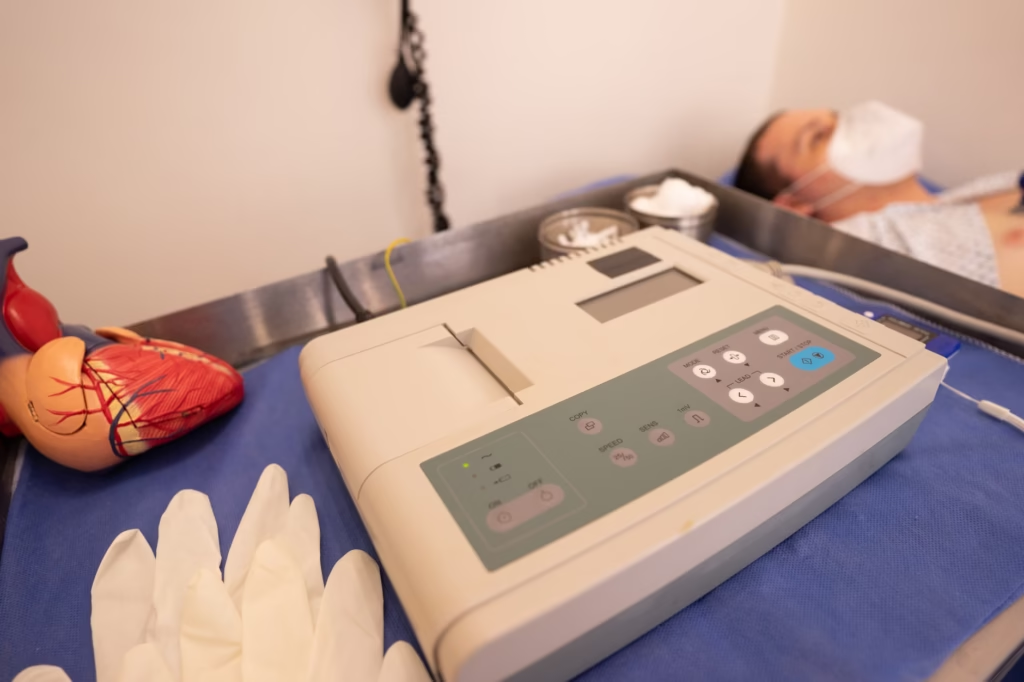
Healthcare AI is even less uniform. FDA’s January 29, 2026 clinical decision support guidance explains that some software functions are excluded from the device definition under specific statutory criteria, while many other software functions still fall under FDA oversight. The FDA AI-enabled device list is updated periodically, but the agency also states that the list is not comprehensive. That matters because investors sometimes mistake a regulatory database for a complete market map. It is not. (fda.gov)
| Segment | What usually creates value | What investors should verify first | Common misread |
|---|---|---|---|
| Biotechnology | Clinical relevance, safety, endpoint quality, and enough capital to reach the next readout. (fda.gov) | ClinicalTrials.gov record, primary outcome measures, adverse events, FDA pathway, and recent SEC filings. (clinicaltrials.gov) | Treating early efficacy signals as if approval and commercial use are already close. |
| Medical devices | Appropriate classification, the right submission pathway, reimbursement, and adoption by clinicians or health systems. (fda.gov) | FDA product classification, 510(k)/De Novo/PMA status, and CMS coverage path. (fda.gov) | Assuming clearance automatically means broad payment or fast sales. |
| Healthcare AI | Clear intended use, validation in the real setting, workflow fit, maintenance plan, and a believable budget owner. (healthit.gov) | Whether it is regulated software, excluded CDS, or part of a device; plus external validation and update discipline. (fda.gov) | Confusing a strong demo or accuracy metric with a durable business model. |
The biggest implication from the table is simple: “innovation” is not the investment thesis. The thesis is the chain that turns innovation into paid care. When that chain breaks, the stock can disappoint even if the underlying science or engineering is real. (cms.gov)
Use the evidence-to-adoption chain
A useful way to compare very different healthcare innovation companies is to walk through the evidence-to-adoption chain in order: clinical need, regulatory route, payment path, workflow fit, and financing. If one link is weak, the company may still be interesting, but the risk is usually higher than the story suggests. (fda.gov)
1. Start with evidence, not excitement
For drugs and biologics, phase numbers tell you stage, not certainty. FDA describes Phase 1 studies as typically involving 20 to 80 people, Phase 2 as a few dozen to about 300, and Phase 3 as several hundred to about 3,000. Accelerated Approval can allow approval for serious conditions based on a surrogate endpoint, which is why investors need to know exactly what endpoint was used and whether it is likely to translate into real clinical benefit. A press release saying a trial “met its primary endpoint” is only the beginning of the work. (fda.gov)
ClinicalTrials.gov is helpful here because it lets investors check the study record, primary outcome definitions, reporting dates, participant flow, adverse events, and any stated limitations or caveats. Those details often reveal whether a headline result came from a randomized design, how enrollment changed over time, and whether results were posted, submitted, or absent. (clinicaltrials.gov)
For devices and healthcare AI, evidence has a different texture. External validation, representative data, intended setting, and update discipline can matter as much as a headline performance metric. ONC’s HTI-1 Decision Support Interventions materials call for transparency around intended users, intended decision-making role, out-of-scope use, external validation, quantitative performance, maintenance, and fairness monitoring. FDA’s AI device work similarly emphasizes lifecycle management and performance evaluation for evolving models. If management cannot explain those basics clearly, the moat may be marketing rather than evidence. (healthit.gov)

2. Identify the exact regulatory route
A strong technology story can still be a poor investment if the regulatory route is fuzzy. FDA’s standard drug development path runs from discovery and preclinical work through clinical research, FDA review, and post-market monitoring. Expedited programs such as Fast Track, Breakthrough Therapy, Accelerated Approval, and Priority Review can change timing, but they do not remove the need to satisfy FDA’s safety and effectiveness standards. In other words, faster is not the same as easier. (fda.gov)
For devices, investors should ask whether the company is pursuing 510(k), De Novo, or PMA, and whether management is discussing an actual authorization or merely a helpful program designation. Breakthrough Device designation can improve interaction with FDA and bring prioritized review, but it is not marketing authorization. De Novo, meanwhile, can create a pathway for novel low-to-moderate risk devices without a predicate and can later establish a predicate for future 510(k) submissions. (fda.gov)
AI complicates this step because “AI” is not a regulatory category by itself. Some software is excluded from the device definition under FDA’s CDS guidance, some is a regulated device software function, and policy around model changes is still evolving. FDA’s PCCP draft guidance is designed to let certain AI-enabled device software functions evolve within pre-specified boundaries, while FDA’s drug-development AI materials and January 2026 Good AI Practice principles emphasize context of use, data governance, risk-based assessment, and lifecycle management. (fda.gov)
3. Ask who pays after authorization
Payment is where many exciting stories slow down. CMS notes that when there is no national coverage policy, Medicare coverage may sit with contractors through local coverage determinations, while national coverage determinations follow a separate process. That means a device, diagnostic, or digital tool can clear one regulatory hurdle and still spend a long time proving it belongs in routine care at scale. (cms.gov)
A recent example shows how material this issue is. On April 23, 2026, CMS and FDA announced the RAPID pathway for certain Class II and Class III Breakthrough Devices aimed at Medicare-relevant unmet needs. The agencies said the pathway is intended to align evidence generation and could, for eligible products, shorten the time from authorization to predictable Medicare national coverage. The point for investors is not that every device will qualify. It is that reimbursement timing can be so consequential that it now drives policy design. (fda.gov)
For biotech, the equivalent question is whether the therapy can move into standard practice and under what coverage conditions. For healthcare AI, the payment question may be even more basic: is the product reimbursed, bundled into another product, sold out of an IT budget, or tied to a pilot or value-based arrangement? If management cannot describe the payer or budget owner in one short sentence, the commercial thesis is still immature.
4. Do not stop at approval day
Approval is not the end of healthcare risk. FDA says the true safety picture of a drug evolves over the months and years after approval, and the agency can change labeling or take stronger actions if new issues emerge. For devices, FDA can require Section 522 postmarket surveillance for certain Class II or III products, and PMA holders face ongoing reporting and study obligations. Investors who model only the approval date and ignore lifecycle obligations can easily overestimate speed, margins, and durability. (fda.gov)
This matters even more for AI tools integrated into care delivery. ONC’s transparency requirements emphasize validation, fairness, local monitoring, maintenance, and update schedules. That is a reminder that a model can perform well in development and still create alert fatigue, weak generalization, or unfair performance when deployed in a different population or setting. (healthit.gov)
5. Decide whether the company can survive the journey
The last link is financing. Investor.gov’s due-diligence materials emphasize using EDGAR and company disclosures to research operations and financial condition, and the SEC also reminds investors that narrow sector funds do not automatically create diversification. In healthcare innovation, where timelines slip and cash needs can change quickly, position size matters almost as much as thesis quality. A good working habit is to read the latest 10-K, 10-Q, and recent 8-Ks before any catalyst rather than relying on slide decks or message boards. (investor.gov)
A hypothetical comparison shows why one checklist is not enough
Consider three hypothetical companies. The first is a cell therapy developer with striking early tumor-response data from a small cohort. The second is a cardiac monitoring device maker with a plausible 510(k) route and obvious clinical utility. The third is an AI triage platform with strong internal validation inside one health system but limited external validation and unclear budget ownership. None of these examples is a real case study; they simply illustrate how different the risk map can look. (fda.gov)
The cell therapy story is primarily an evidence, manufacturing, and financing bet. The cardiac monitor is more likely to become a regulatory, reimbursement, and sales-execution bet. The AI platform is mainly a validation, workflow, maintenance, and payment-model bet. All three may be genuinely innovative. But they fail for different reasons, and they deserve different position sizes, time horizons, and confidence levels. (fda.gov)
Common mistakes that distort healthcare innovation investing
- Confusing program status with product success. Fast Track, Breakthrough Therapy, Breakthrough Device designation, or other expedited features can improve process and visibility, but they do not equal approval, coverage, or durable revenue. (fda.gov)
- Reading only company communications. Press releases summarize; they do not replace the study record, FDA databases, or SEC filings. (clinicaltrials.gov)
- Treating a regulatory list as a full market map. FDA explicitly says its AI-enabled device list is not comprehensive. (fda.gov)
- Ignoring promotion risk in small names. The SEC warns that unsolicited promotions, unusual stock-price moves, frequent business-plan changes, and promotion that seems heavier than the product itself can be warning signs of microcap fraud. (investor.gov)
- Assuming a sector ETF solves concentration risk. Investor.gov notes that a mutual fund or ETF may still be narrowly focused and may require additional holdings to create real diversification. (investor.gov)
A practical diligence routine before you buy
- Map the product to the right bucket. Decide whether the company is primarily a drug or biologic story, a device story, or a software story. Then identify the likely regulatory path: clinical development and NDA/BLA, 510(k), De Novo, PMA, or a software category addressed in FDA guidance. (fda.gov)
- Read the primary evidence source. For therapies, review ClinicalTrials.gov for the study design, primary outcome measures, results status, adverse events, and timing. For devices and AI, look for validation setting, intended users, and evidence that matches the real use case. (clinicaltrials.gov)
- Verify the company’s regulatory claims in official databases. Use FDA’s device databases, AI-enabled device materials, or approval resources instead of assuming the investor presentation is complete. (fda.gov)
- Ask the payment question before the technology question. Check whether coverage is likely to depend on an NCD, LCD, another payer process, or an enterprise software budget. If Medicare matters, understand whether the company’s narrative actually fits existing CMS pathways or only a future possibility. (cms.gov)
- Read the filings and size the position accordingly. EDGAR gives free access to company disclosures, and SEC investor materials consistently frame research and diversification as core parts of due diligence. If the name is small, thinly traded, or heavily promoted, be even more skeptical. (investor.gov)

A disciplined process will not remove uncertainty. It does something better: it helps separate productive risk from sloppy risk. In healthcare innovation, that distinction is where a lot of long-term returns are made or lost.
The real edge is understanding where the story can break
Biotechnology, medical devices, and healthcare AI all promise better care, but they travel through different gates on the way to revenue. The best healthcare innovation investors are usually not the ones making the biggest future-of-medicine claims. They are the ones asking the most grounded questions about evidence, regulation, reimbursement, workflow, and balance-sheet durability.
If there is one practical next step, it is this: before buying any healthcare innovation name, write down the next clinical, regulatory, payment, and financing milestone in plain English. If the company reaches only one of those four and misses the others, decide in advance whether the stock is still investable. That habit alone can improve judgment more than chasing the newest theme.
Frequently Asked Questions
Is biotech automatically the highest-upside segment?
Not automatically. Biotech often has the most obvious binary catalysts because of staged clinical development and safety or efficacy readouts, but devices and AI can also create strong returns when evidence, coverage, and adoption line up. The key distinction is that the main source of uncertainty differs by segment. (fda.gov)
Does Breakthrough Therapy or Breakthrough Device status make a company safer to own?
No. Those designations can improve interaction with FDA or speed parts of the review process, but they are not the same as approval, commercialization, or reimbursement. They should be viewed as process advantages, not proof that the investment thesis is complete. (fda.gov)
Where can investors verify a healthcare company’s claims?
Start with EDGAR for filings, ClinicalTrials.gov for registered studies and results, FDA databases and guidance pages for regulatory status, and CMS materials for coverage pathways. Those sources are far more reliable than relying only on investor decks or social media summaries. (investor.gov)
Can a healthcare AI company avoid FDA entirely?
Sometimes, but not by default. FDA’s clinical decision support guidance explains that some software functions are excluded from the device definition under specific criteria, while other software functions remain regulated medical devices. Investors should want a precise explanation of where the product fits. (fda.gov)
Are healthcare ETFs enough for diversification?
Not necessarily. Investor.gov notes that a mutual fund or ETF may still be narrowly focused, especially if it concentrates on one sector or theme. Check the top holdings and overlap before assuming a healthcare innovation fund gives broad diversification. (investor.gov)
References
- FDA – The Drug Development Process – https://www.fda.gov/patients/learn-about-drug-and-device-approvals/drug-development-process
- FDA – Fast Track, Breakthrough Therapy, Accelerated Approval, Priority Review – https://www.fda.gov/patients/learn-about-drug-and-device-approvals/fast-track-breakthrough-therapy-accelerated-approval-priority-review
- FDA – Classify Your Medical Device – https://www.fda.gov/medical-devices/overview-device-regulation/classify-your-medical-device
- FDA – De Novo Classification Request – https://www.fda.gov/medical-devices/premarket-submissions-selecting-and-preparing-correct-submission/de-novo-classification-request
- FDA – Artificial Intelligence-Enabled Medical Devices – https://www.fda.gov/medical-devices/software-medical-device-samd/artificial-intelligence-enabled-medical-devices
- FDA – Clinical Decision Support Software – https://www.fda.gov/regulatory-information/search-fda-guidance-documents/clinical-decision-support-software
- FDA – Artificial Intelligence for Drug Development – https://www.fda.gov/about-fda/center-drug-evaluation-and-research-cder/artificial-intelligence-drug-development?trk=public_post_comment-text
- CMS – Medicare Coverage Determination Process – https://www.cms.gov/medicare/coverage/determination-process
- FDA – CMS and FDA Announce RAPID Coverage Pathway to Accelerate Patient Access to Life-Changing Medical Devices – https://www.fda.gov/news-events/press-announcements/cms-and-fda-announce-rapid-coverage-pathway-accelerate-patient-access-life-changing-medical-devices
- ClinicalTrials.gov – How to Read Study Results – https://clinicaltrials.gov/study-basics/how-to-read-study-results
- ClinicalTrials.gov – Protocol Registration Data Element Definitions – https://clinicaltrials.gov/policy/protocol-definitions
- Investor.gov – Researching Investments – https://www.investor.gov/introduction-investing/getting-started/researching-investments
