
Most portfolios are not really reacting to headlines. They are reacting to what those headlines do to corporate earnings, interest rates, inflation, currencies, and investor risk appetite. As of the IMF’s July 8, 2026, World Economic Outlook Update, global growth was still projected at 3.0% for 2026 and 3.4% for 2027, but the Fund said the expansion was uneven, with war-related energy shocks pushing against technology-led investment. The Federal Reserve’s June 17, 2026, statement kept the federal funds target range at 3.5% to 3.75% and said inflation remained elevated partly because supply shocks had raised energy prices. That is the practical link between global economics and your account balance: a global trend matters when it changes the forces that reprice the assets you already own. (imf.org)
- Global trends usually reach portfolios through four channels: growth, rates, inflation and commodities, and currencies.
- A macro forecast is an input, not an instruction to make a big trade.
- The most useful response is often rebalancing around real risk exposures, not chasing the latest theme.
- International diversification, bond duration, cash, and TIPS each solve different problems.
Global headlines move portfolios through four transmission channels
If a reader remembers only one idea from this article, it should be this: global events do not affect every investment directly, and they do not affect all portfolios in the same way. The important question is not whether a trend sounds important on television. The important question is how it travels into the holdings, funds, and cash needs that matter in real life. (imf.org)
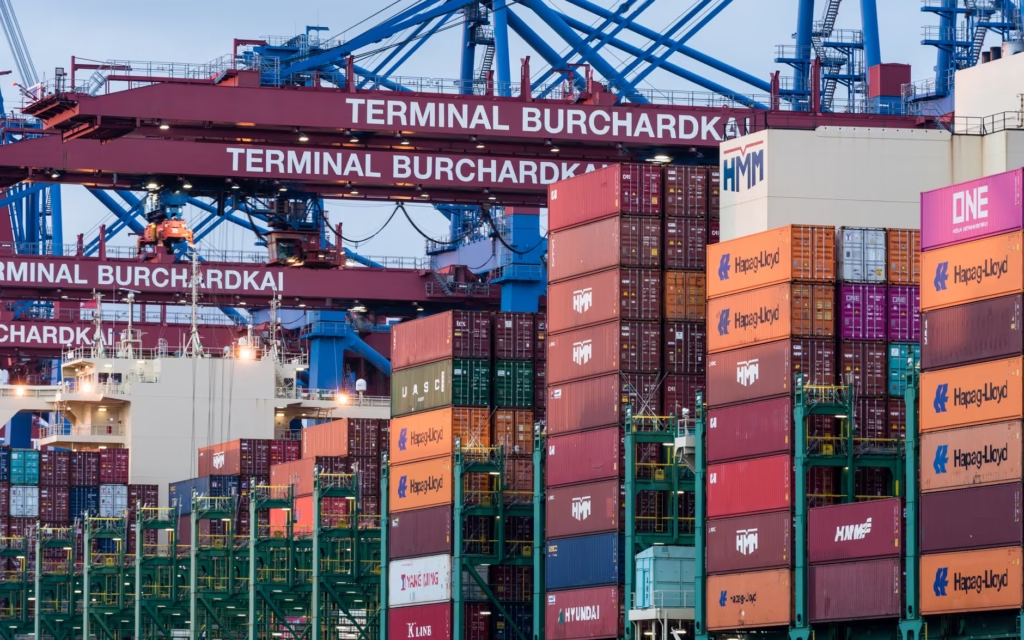
- Growth channel: When world demand slows, speeds up, or becomes more uneven across regions, revenue expectations change. Exporters, cyclical industries, commodity producers, and many emerging-market assets can feel that change quickly. The IMF’s July 2026 update and the World Bank’s June 11, 2026, outlook both emphasized that growth remains vulnerable to conflict, borrowing costs, and uneven regional conditions. (imf.org)
- Rates channel: Central-bank policy and bond yields change the discount rate investors apply to future cash flows. That is why the same company can be worth less in the market even if its business has not suddenly deteriorated. Higher policy rates and tighter financial conditions can pressure long-duration bonds and richly valued growth stocks at the same time. (federalreserve.gov)
- Inflation and commodity channel: Energy, fertilizer, shipping, and metals shocks can raise business costs, squeeze consumers, and keep central banks cautious. The World Bank’s April 2026 commodity outlook projected energy prices rising 24% in 2026 and overall commodity prices up 16% under its assumptions, while the OECD warned in June 2026 that a prolonged disruption could intensify inflation and tighten global financial conditions. (worldbank.org)
- Currency and liquidity channel: The Federal Reserve’s H.10 dollar indexes track the dollar against major trading partners. When the dollar moves sharply, U.S. investors in unhedged foreign assets can see local-market gains or losses translated into very different dollar returns, and global funding conditions can change along with that move. (federalreserve.gov)
This is why “the economy” and “the market” are never identical. A soft global backdrop can still produce strong returns in a narrow slice of the market, while a seemingly decent economy can be painful for a portfolio loaded with the wrong interest-rate, valuation, or currency exposure. (imf.org)
Use the Portfolio Transmission Check before changing allocations
The SEC’s investor guidance focuses on asset allocation, diversification, and rebalancing. A useful adaptation for global macro news is a simple Portfolio Transmission Check: trace a major economic story through the holdings you own before deciding whether to act. This is an editorial decision tool, not a standardized professional model, but it can help turn vague concern into something more measurable. (sec.gov)
- Name the shock in plain English. “Global growth is slowing” is not precise enough. “Higher energy prices may keep inflation sticky and borrowing costs elevated” is much more useful.
- List the holdings that would feel the shock first. That might be long-term bonds, international funds, small-cap cyclicals, energy producers, or expensive growth stocks.
- Check for repeated exposure across accounts. Many investors think they own ten different ideas when several ETFs or funds are really tied to the same macro risk.
- Compare the risk with your time horizon. A retiree drawing income next year should judge the shock differently from a worker investing for 30 years.
- Choose one of three responses only: rebalance back to target, diversify a concentrated risk, or do nothing. If a headline does not justify one of those actions, it probably does not justify a trade.
A portfolio can look diversified by ticker count and still be highly concentrated by macro exposure.
The global trends that matter most right now
The mid-2026 backdrop is a good reminder that forecasts are useful but imperfect. On July 8, 2026, the IMF projected global growth of 3.0% for 2026. On June 11, 2026, the World Bank’s Global Economic Prospects release forecast 2.5% growth for 2026 under its assumptions. Investors should not treat that difference as proof that one institution is right and the other is wrong. It is better understood as evidence that economic outlooks are scenario-based and sensitive to energy prices, trade conditions, borrowing costs, and the exact assumptions used in the model. (imf.org)

| Trend | How it typically reaches a portfolio | Holdings that can be more sensitive | Better response than a headline trade |
|---|---|---|---|
| Slower but uneven global growth (imf.org) | Earnings expectations, regional demand, and sector leadership change. | Global cyclicals, exporters, single-country bets, emerging-market funds. | Review how much of the portfolio depends on one growth narrative. |
| Sticky inflation and restrictive rates (federalreserve.gov) | Discount rates stay higher and borrowing-sensitive sectors lose support. | Long-duration bonds, rate-sensitive stocks, leveraged businesses. | Match bond duration to spending horizon instead of guessing the next rate move. |
| Energy and commodity shocks (worldbank.org) | Input costs rise, margins shift, and inflation expectations can reset. | Consumers, transport, energy importers, narrow “inflation hedge” trades. | Use inflation tools carefully rather than assuming any commodity-linked asset is protective. |
| Large dollar swings (federalreserve.gov) | Foreign returns translate back into more or fewer U.S. dollars. | Unhedged international funds, multinational firms, emerging-market debt. | Decide whether you want currency exposure rather than inheriting it by accident. |
| Tighter financial conditions and repricing risk (imf.org) | Risk appetite falls, refinancing gets harder, and volatility spreads across asset classes. | Speculative assets, highly leveraged companies, investors with low cash buffers. | Stress-test cash needs and rebalance before a forced sale becomes necessary. |
The important point is that these trends do not stay in separate boxes. An energy shock can lift inflation, keep central banks cautious, raise discount rates, weaken consumer spending, and tighten financial conditions all at once. That is why a portfolio review based on one asset label at a time often misses the bigger risk. (oecd.org)
Why the same macro shock hurts one investor and barely dents another
This is where broad advice like “buy stocks for the long run” or “move to safety” stops being helpful. The same global event can hurt two investors in very different ways because their portfolios may carry very different combinations of valuation risk, duration risk, currency risk, and liquidity needs.
Example: an energy shock does not stay in the energy sector
Consider two hypothetical investors with identical account sizes. Portfolio A is concentrated in U.S. large-cap growth funds and long-term nominal Treasuries, with very little international exposure and no dedicated inflation protection. Portfolio B holds a broad U.S. stock fund, a meaningful but not dominant international stock allocation, shorter- or intermediate-term bonds, some TIPS, and a cash reserve for near-term needs. If energy prices jump and inflation stays persistent, Portfolio A can be hit twice: higher discount rates can pressure both long-duration bonds and richly valued stocks. Portfolio B may not avoid losses, but its shorter bond exposure, explicit inflation-linked holdings, and wider regional mix can make the shock less destabilizing. TreasuryDirect explains that TIPS adjust principal with inflation and deflation and repay the adjusted or original principal at maturity, whichever is greater, which is why they can play a specific role inside a fixed-income allocation. (savingsbond.gov)
International diversification gets misunderstood in a similar way. Foreign stocks are not a universal hedge against U.S. problems, and a strong dollar can reduce translated returns for U.S.-based investors in unhedged foreign funds. But a portfolio invested almost entirely in one country can become much more dependent on one policy regime, one market leadership cycle, and one valuation environment than many investors realize. The SEC notes that diversification depends on how money is spread among investments, not simply on the number of funds shown on a brokerage screen. (sec.gov)
What to do without turning your portfolio into a macro trading desk
Most investors do not need to predict oil, trade policy, or every central-bank meeting. They do need a portfolio structure that can survive being wrong. In practice, that usually means disciplined rebalancing, a bond allocation matched to real spending needs, and deliberate choices about international exposure, cash, and inflation protection. (sec.gov)

A practical action plan
- Set target ranges, not one exact number. For example, think in ranges for stocks, bonds, cash, and international exposure so the portfolio has room to move without feeling broken.
- Rebalance on a schedule or after meaningful drift. The SEC notes that many investors use calendar-based reviews or preset percentage thresholds, and that rebalancing works best when it is relatively infrequent rather than constant. (sec.gov)
- Match bond duration to when the money is needed. Near-term spending should not depend on long-duration assets that can swing sharply when rate expectations change.
- Use inflation tools for the inflation problem. TIPS can make sense for the part of fixed income meant to preserve purchasing power, but they are not a substitute for emergency cash or broad diversification. (savingsbond.gov)
- Keep liquidity separate from return-seeking assets. A cash reserve can help prevent forced selling when global conditions suddenly tighten.
One overlooked point is that a good macro thesis can still lead to a bad portfolio decision if the account is taxable, the trade triggers realized gains, or the investor is solving the wrong problem. The SEC specifically notes that rebalancing methods can create transaction fees or tax consequences, which is a reminder that portfolio management is not just about being right on the economy. It is also about implementation. (sec.gov)
Currency exposure also deserves an intentional decision. The Federal Reserve describes the broad dollar index as a weighted average of the dollar against major U.S. trading partners. That sounds technical, but the portfolio implication is straightforward: foreign diversification and foreign-currency exposure are related, not identical. Some investors want that currency variation as part of diversification. Others prefer less of it. What matters is choosing the exposure, not discovering it after a volatile quarter. (federalreserve.gov)
Common mistakes when investors react to global trends
- Turning one forecast into an all-in allocation change. In mid-2026, the IMF and World Bank were both describing a fragile backdrop, but they were not publishing identical global growth numbers. Forecasts are scenario tools, not guarantees. (imf.org)
- Owning the same risk in several wrappers. A portfolio can hold multiple ETFs and still be dominated by one factor, such as long-duration growth, U.S. mega-cap concentration, or energy sensitivity.
- Chasing the last shock. After a commodity spike, investors often buy whatever recently looked like an inflation hedge. After yields fall, they often reach for duration without reconsidering whether the money is actually long term.
- Ignoring taxes, fees, and life stage. The SEC notes that time horizon, risk tolerance, and rebalancing costs all matter. A sensible move for a 30-year retirement account may be a poor move for money needed in two years. (sec.gov)
Signals worth monitoring once a quarter
- Official growth revisions from major institutions. IMF, World Bank, and OECD updates are more useful than social-media certainty because they show what assumptions are changing. (imf.org)
- Central-bank statements and projections. Policy rates do not just affect bonds; they shape valuation pressure across equities and credit. (federalreserve.gov)
- Inflation trends and market inflation compensation. The Federal Reserve notes that breakeven inflation can be derived by comparing nominal Treasury yields with TIPS yields of similar maturities, giving investors one market-based read on inflation expectations. (federalreserve.gov)
- Energy and key commodity direction. Commodity shocks often spill beyond the commodity sector into margins, consumer behavior, and central-bank reaction functions. (worldbank.org)
- The broad dollar and signs of tighter financial conditions. Currency moves and sudden repricing in financial markets can matter even when GDP headlines have not yet fully changed. (federalreserve.gov)
This article is general information, not personalized investment, tax, or legal advice. If retirement timing, a concentrated position, or a taxable account makes the stakes higher, a qualified financial or tax professional can help translate macro concerns into a portfolio plan.
A useful way to think about the next headline
The next global scare will arrive with a different name, a different map, and a different set of talking points. The discipline that usually holds up is simpler than the commentary around it: understand the transmission channel, check the exposures you already own, rebalance when the portfolio has drifted away from your plan, and resist the urge to turn every macro story into a trade. Global economics matters. But for most long-term investors, portfolio structure matters more.
FAQ
Should I sell stocks when global growth forecasts are cut?
Not automatically. Forecasts can differ by institution and can change quickly as assumptions change. A better first step is to check whether the downgrade changes your portfolio’s actual risk profile or only your comfort level. Rebalancing back to target is often more useful than making a big directional bet from one forecast. (imf.org)
Do international stocks still make sense if the dollar is strong?
They can. A strong dollar can reduce translated returns on unhedged foreign holdings, but that does not erase the diversification case for not concentrating everything in one country. The more important decision is whether the currency exposure is intentional and appropriate for the investor’s goals and risk tolerance. (federalreserve.gov)
Are TIPS always the best answer when inflation is a concern?
No. TIPS are designed for a specific job inside fixed income: TreasuryDirect says their principal adjusts with inflation and deflation, and at maturity investors receive the adjusted principal or the original principal, whichever is greater. That can be useful, but it does not solve every portfolio problem or replace the need for cash, diversification, and suitable time-horizon matching. (savingsbond.gov)
How often should a portfolio be rebalanced during economic uncertainty?
The SEC says investors commonly use either calendar-based rebalancing, such as every six or 12 months, or threshold-based rebalancing after an asset class drifts by a preset amount. In either case, the agency notes that rebalancing tends to work best when done relatively infrequently rather than constantly, and that taxes and fees should be considered before acting. (sec.gov)
References
- IMF – World Economic Outlook Update, July 2026 – https://www.imf.org/en/publications/weo/issues/2026/07/08/world-economic-outlook-update-july-2026?cid=ca-com-homepage-WEOET2026004
- IMF – Global Financial Stability Report, April 2026 – https://www.imf.org/en/publications/gfsr/issues/2026/04/14/global-financial-stability-report-april-2026
- Federal Reserve – FOMC Statement, June 17, 2026 – https://www.federalreserve.gov/newsevents/pressreleases/monetary20260617a.htm?ftag=MSFd61514f
- Federal Reserve – Foreign Exchange Rates H.10, Nominal/Real Indexes – https://www.federalreserve.gov/releases/h10/summary/default.htm
- SEC – Beginners’ Guide to Asset Allocation, Diversification, and Rebalancing – https://www.sec.gov/about/reports-publications/investorpubsassetallocationhtm
- TreasuryDirect – Treasury Inflation-Protected Securities (TIPS) – https://www.savingsbond.gov/marketable-securities/tips/
- World Bank – Global Economic Prospects Press Release, June 11, 2026 – https://www.worldbank.org/en/news/press-release/2026/06/11/global-economic-prospects-june-2026-press-release
- World Bank – Commodity Markets Outlook, April 2026 – https://www.worldbank.org/en/research/commodity-markets
- OECD – Global Economic Outlook Weakens Amid Energy Shock and Rising Inflationary Pressures, June 2026 – https://www.oecd.org/en/about/news/press-releases/2026/06/global-economic-outlook-weakens-amid-energy-shock-and-rising-inflationary-pressures.html?wcmmode=disabled.html%27
